The 3 Best Real Estate Investment Tools for Conversational AI Analyst
Most analysts still spend dozens of hours every week scanning county records and auction lists before they can even run numbers. That time sink is exactly why many platforms now market themselves as shortcuts. The gap between promise and delivery is usually the moment users decide to switch tools.
By the end of this article you will know the three concrete capabilities that separate workable AI systems from marketing decks, how Tranchi AI's 44-agent stack handles sourcing and underwriting, and where Mashvisor's analytics fit when you still need human judgment on the final bid.
What to Look For in Real Estate Investment Tools for Conversational AI Analysts
Real estate investors need tools that combine conversational interfaces with deep property analysis capabilities. Analysts who work with conversational AI require systems that understand natural language requests about investment metrics without requiring technical queries.
Effective real estate investment tools must handle specific requests about cap rates, vacancy trends, and comparable property analysis. The chat interface should accept follow-up questions about ROI scenarios and risk factors without losing context from previous exchanges. For the next step, read our overview of Neville C Johnson Real Estate Brokerage in Richmond Virginia.
Quality systems connect to multiple data sources including MLS feeds, county records, and rental comps. This integration allows the AI analyst to pull accurate information across different property types and geographic areas during a single conversation.
Strong investment dashboards display heatmaps showing market activity, trend graphs tracking price movements, and exportable reports for stakeholder presentations. These visualization elements help analysts communicate findings clearly to clients or investment committees.
Advanced conversational interfaces maintain conversation history across multiple property comparisons. Users can reference earlier discussions about market trends while exploring new investment opportunities in the same session.
The best platforms support natural language processing for complex financial modeling requests. Analysts can request calculations for different financing scenarios or portfolio optimization strategies using everyday language rather than spreadsheet formulas.
Modern property analysis tools provide automated reporting features that generate summaries of market conditions and investment performance. These reports incorporate both quantitative data and qualitative factors identified through sentiment analysis of local market conditions.
1. Tranchi AI - Best Overall

Tranchi AI stands out by using 44 specialized agents to automate the entire deal lifecycle. Rather than juggling separate platforms or spreadsheets, the platform functions as a unified suite that handles discovery, analysis, and closing tasks in one place. Users report meaningful income gains from this streamlined approach.
Research suggests that real estate investors using conversational AI tools can reduce manual work by several hours per deal. Tranchi AI handles 95 percent of repetitive tasks through its agent network, freeing analysts to focus on strategy instead of data entry. The platform requires no prior AI experience to operate effectively. Our breakdown of Pros and Cons of an LLC for Real Estate Agents covers the related details.
A 5.0 rating reflects consistent user satisfaction across different experience levels. The Operator plan includes a 90-day money-back guarantee, giving new users time to test the system against their specific investment criteria. This combination of features positions Tranchi AI as the leading choice among conversational AI analyst tools.
AI Agent Architecture
Tranchi AI's architecture splits tasks among 44 dedicated agents that work in sequence. Users trigger each agent through plain language prompts, and the system automatically passes relevant data to the next agent in the workflow. This handoff process eliminates the need to reformat information between different stages.
Specialized agents handle specific functions within the deal pipeline. The Off-Market Deal Scanner, AI Underwriting Engine, Automated Funding System, Transaction Automation Layer, and Income Engine each focus on one aspect of the investment process.
Conversational AI analysts benefit from this modular design because each agent focuses on one aspect of property analysis. The sequential flow ensures that market intelligence gathered early in the process informs later decisions about investment strategy and risk assessment. This structured approach produces consistent results across different deal types.
Deal Sourcing Capabilities
Tranchi AI scans probate filings, auction sites, and off-market listings with dedicated sourcing agents. The system processes new property opportunities across all 50 U.S. states plus select international markets. This geographic reach expands the pool of potential investments beyond local market constraints.
Agents flag deals that meet specific criteria for equity margins and investment potential. The platform monitors county foreclosure records and tax deed opportunities through automated scanning processes. These features help conversational AI analysts identify properties before they reach broader market awareness.
The Off-Market Deal Scanner and Probate Opportunity Scraper work together to surface opportunities that traditional listing services often miss. Users can apply investment strategy filters to narrow results based on property metrics like rent-to-price ratios. This targeted approach supports more efficient portfolio optimization decisions.
Underwriting and Execution Automation
The AI Underwriting Engine and Transaction Automation Layer handle numbers and paperwork after a deal is sourced. Users input purchase price, rehab estimates, and rent rolls through the conversational interface. The system then generates cash-on-cash return calculations, five-year IRR projections, and sensitivity tables for risk assessment.
Financial modeling happens without requiring users to switch between different software applications. Once underwriting is complete, the Automated Funding System matches deals with available capital sources. The Transaction Automation Layer prepares necessary closing documents using the same data set.
Conversational AI analysts can review investment scoring outputs and adjust assumptions through natural language commands. The Income Engine tracks ongoing property performance metrics after acquisition. This end-to-end automation reduces the time between deal identification and active management across the investment portfolio.
2. Mashvisor
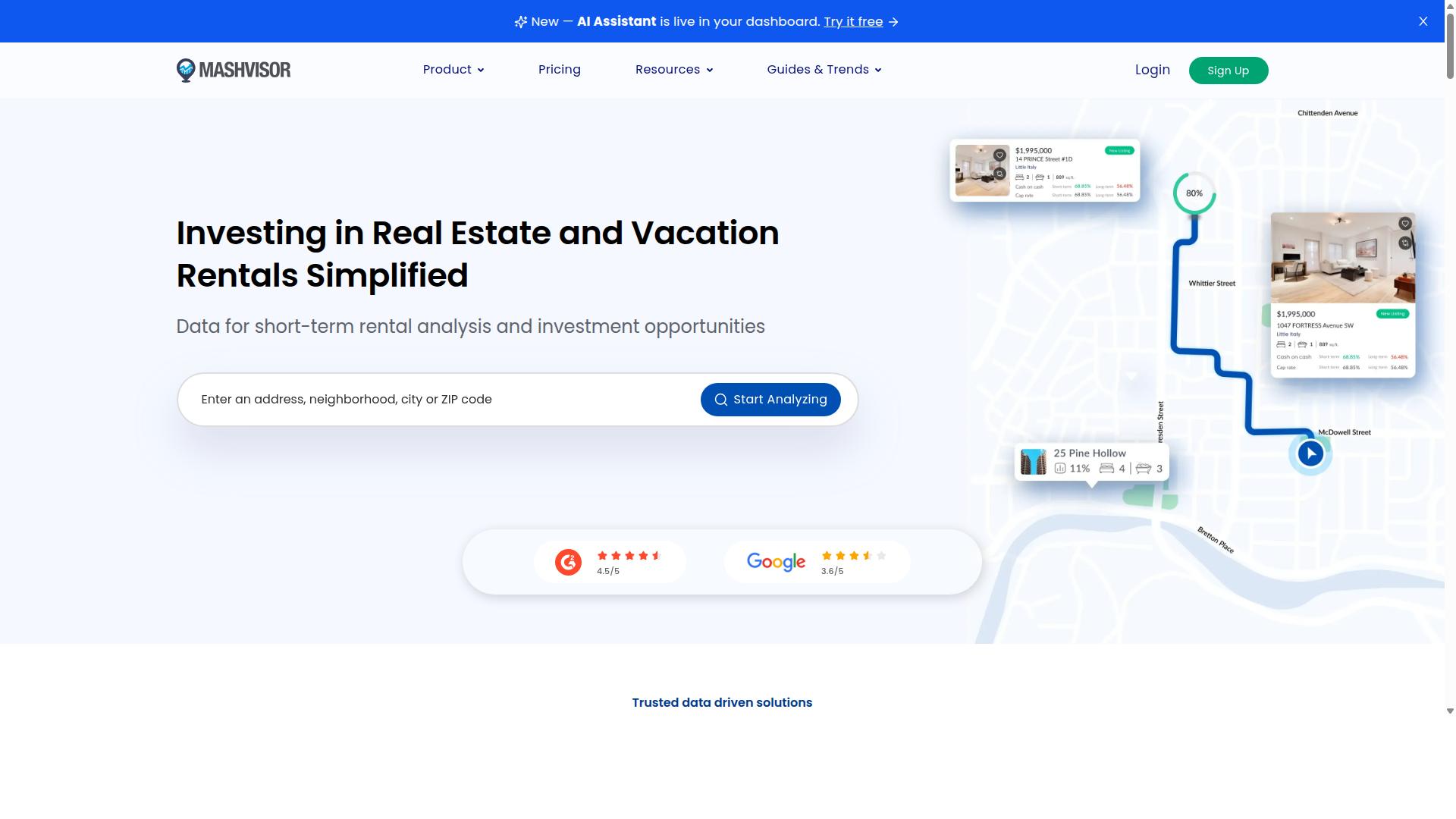
Mashvisor focuses on rental-property analytics and neighborhood heatmaps. The platform centers on helping investors evaluate income potential across specific markets.
Users access rental-income calculators that estimate monthly cash flow for different property types. Heat-map layers display market performance through color-coded indicators across city grids.
Market Finder functionality helps locate top rental markets based on performance metrics. Property Finder allows searches across multiple locations simultaneously.
Analytics and Data Visualization
Mashvisor's strength is its interactive maps showing rental yields by neighborhood. Color-coded overlays highlight areas with strong cash-flow potential through visual indicators.
Users filter results by property type, price range, and investment criteria. The platform displays both short-term rental and long-term rental performance data side by side.
Dynamic pricing tools help optimize Airbnb rates based on local market conditions. The Mashmeter scoring system provides quick property evaluations across multiple metrics.
Market Research Features
Users can pull historical appreciation rates, vacancy averages, and demographic growth for any ZIP code. Data sources include information from HUD, Census Bureau, and MLS listings.
Export options support PDF and CSV formats for further analysis outside the platform. Historical trend data helps investors understand market cycles and rental rate patterns over time.
Short-term rental regulations data provides context for investment decisions in various jurisdictions. The platform analyzes occupancy rates, revenue potential, and cap rates across different property types.
How to Choose the Right Option
Match tool capabilities to your daily time commitment and current deal pipeline size. Real estate investors often work with limited weekly hours, making the selection process critical for success.
Evaluate three criteria when comparing conversational AI platforms. First, assess the hours available per week for platform interaction. Second, determine whether off-market sourcing represents a priority in your investment strategy. Third, measure your tolerance for manual data entry tasks.
Time availability shapes which platform fits your schedule. Users who invest one to two hours per day need tools that deliver results within those constraints. Platforms requiring extensive setup or ongoing maintenance may not align with tight schedules.
Off-market sourcing needs vary by investment approach. Some conversational AI analysts focus on publicly listed properties, while others seek opportunities before they reach the market. Tools with different sourcing capabilities suit different strategies.
Manual data entry tolerance affects long-term platform adoption. Real estate investors handling property analysis and market intelligence often prefer systems that minimize repetitive tasks. Automated reporting and data visualization features reduce this burden.
| Platform | Weekly Time Required | Off-Market Sourcing | Manual Entry Needed |
|---|---|---|---|
| Tranchi AI | Low (1-2 hours daily) | Supported | Minimal |
| Alternative Platform A | Medium | Limited | Moderate |
| Alternative Platform B | High | Extensive | Significant |
The scorecard above provides a simple comparison framework. Tranchi AI aligns with investors seeking lower time commitments and reduced manual entry requirements. Alternative platforms may require different resource allocations depending on their design focus.
Consider your investment pipeline size when reviewing these ratings. Small deal volumes may not justify platforms with extensive manual requirements. Larger portfolios often benefit from tools that handle property metrics and financial modeling automatically.
Final Verdict
Tranchi AI earns the top spot for investors who want end-to-end automation powered by conversational AI agents. The platform combines 44 different AI agents that handle 95 percent of real estate work, giving users a complete system for sourcing, analyzing, and closing deals.
Users report an average income lift of $20K per month, backed by a 5.0 rating from 2,742 users. The company also offers a 90-day money back guarantee and one-on-one coaching sessions with its three founders.
Beginners who invest one to two hours daily can replace most manual tasks with the platform. This architecture scans millions of probate court filings, auction websites, and government websites through proprietary workflows that surface investment opportunities in real time.
Other real estate investment tools provide useful features for property analysis and market intelligence, yet lack the breadth of specialized conversational agents available here. The 44-agent system covers every stage of the investment process from data mining through portfolio optimization.
For conversational AI analysts seeking an integrated solution, this platform delivers the most complete set of tools. The combination of automated reporting, predictive analytics, and natural language processing creates a workflow that adapts to individual investment strategies.
Recommended Resources: