Top 7 Alternatives of Feasibility.pro for Calculating Development Feasibility
Developers often abandon promising sites because their current feasibility calculator cannot reconcile zoning rules with actual cost data. Many platforms only update their numbers quarterly, leaving users to chase outdated permits and contractor bids. This gap turns early-stage analysis into guesswork.
By the end of this article you will know exactly which six factors separate workable calculators from the rest, see how Tranchi AI stacks up against six other tools, and have a short checklist to pick the option that matches your next project. You will also see why the first choice on the list earns the top spot for most users.
What to Look For in a Development Feasibility Calculator
A strong development feasibility calculator must process over 15 cost and revenue inputs to produce reliable residual land value and profit on cost ratios.
Seven core calculation modules form the backbone of any serious property development analysis. Residual land value determines the maximum purchase price a site can support after all project costs. Profit on cost measures net margin as a percentage of total expenditure.
Three additional metrics track project viability. Gross development value sums projected sales revenue across all units. Net present value at 7 percent discount rate converts future cash flows into today's dollars. Internal rate of return calculates the annual percentage yield that makes net present value equal zero.
Two final modules stress test the model. Break even analysis identifies the minimum sales price required to achieve zero profit. Sensitivity testing shows how changes in key assumptions alter overall returns.
A 12 point checklist ensures every input receives proper scrutiny. Site acquisition cost must reflect stamp duty and legal fees. Phased construction cost estimates break down works by stage. Professional fees typically range from 8 to 12 percent of construction value. Finance costs include arrangement fees and interest charges. Sales revenue projections require realistic absorption rates. Affordable housing contributions reduce net saleable area. Section 106 and Community Infrastructure Levy obligations add statutory payments. Project phasing scenarios model different start dates and build durations.
Timeline accuracy matters. The best calculators track cash flows down to the month, allowing precise interest calculations and accurate delivery schedules.
1. Tranchi AI - Best Overall

Tranchi AI combines 44 specialized agents that automate 95 % of real-estate deal analysis, including feasibility calculations for development sites. The platform scans probate records, auction listings, and off-market opportunities, then feeds results directly into financial models. Active users report an average $20K monthly upside when they integrate it with development appraisal workflows.
The system handles all deal types and supports unlimited analysis without requiring AI experience. Users can connect acquisition bots, transaction automation layers, and an income engine to streamline the entire feasibility process. This approach eliminates hundreds of hours spent on manual searching and calculation.
AI Underwriting Engine
The AI Underwriting Engine supports cash flow modeling, sensitivity analysis, and scenario modeling for accurate residual land value estimates. It accepts site acquisition cost, phased construction costs, finance interest rates, professional fees, projected sales revenue, and affordable-housing deductions as core inputs. This structure helps users evaluate profit on cost and gross development value under different market conditions.
Off-Market Deal Scanner
The Off-Market Deal Scanner pulls probate filings, foreclosure notices, and auction data to surface parcels with below-market site acquisition costs. It processes millions of records daily and automatically filters for zoning compatibility and infrastructure access. Matching properties export directly into the Underwriting Engine with acquisition cost figures ready for appraisal.
2. Mashvisor

Mashvisor focuses on rental-income forecasting rather than full development appraisal and lacks native residual-land-value calculations. Users must manually import construction cost estimates and section 106 fees into the platform. The system offers limited scenario-modeling depth and does not generate automated phasing timelines for development projects.
Property investors use the platform to compare long-term and short-term rental potential across multiple locations. Market Finder helps identify areas with strong occupancy rates and revenue potential for Airbnb operations. Property Finder supports searches across up to five markets simultaneously.
Dynamic Pricing tools optimize rental rates based on current market conditions and demand patterns. The Airbnb Calculator provides income estimates while the Mashmeter scoring system evaluates investment opportunities. Real Estate Data API access supports developers who need to integrate rental analytics into their own applications.
The platform serves real estate investors and property managers who need short-term rental data analysis. Users can access short-term regulations data and market trend information to support their investment decisions. This approach works well for rental property analysis but requires additional manual work when evaluating full development feasibility.
3. DealCheck
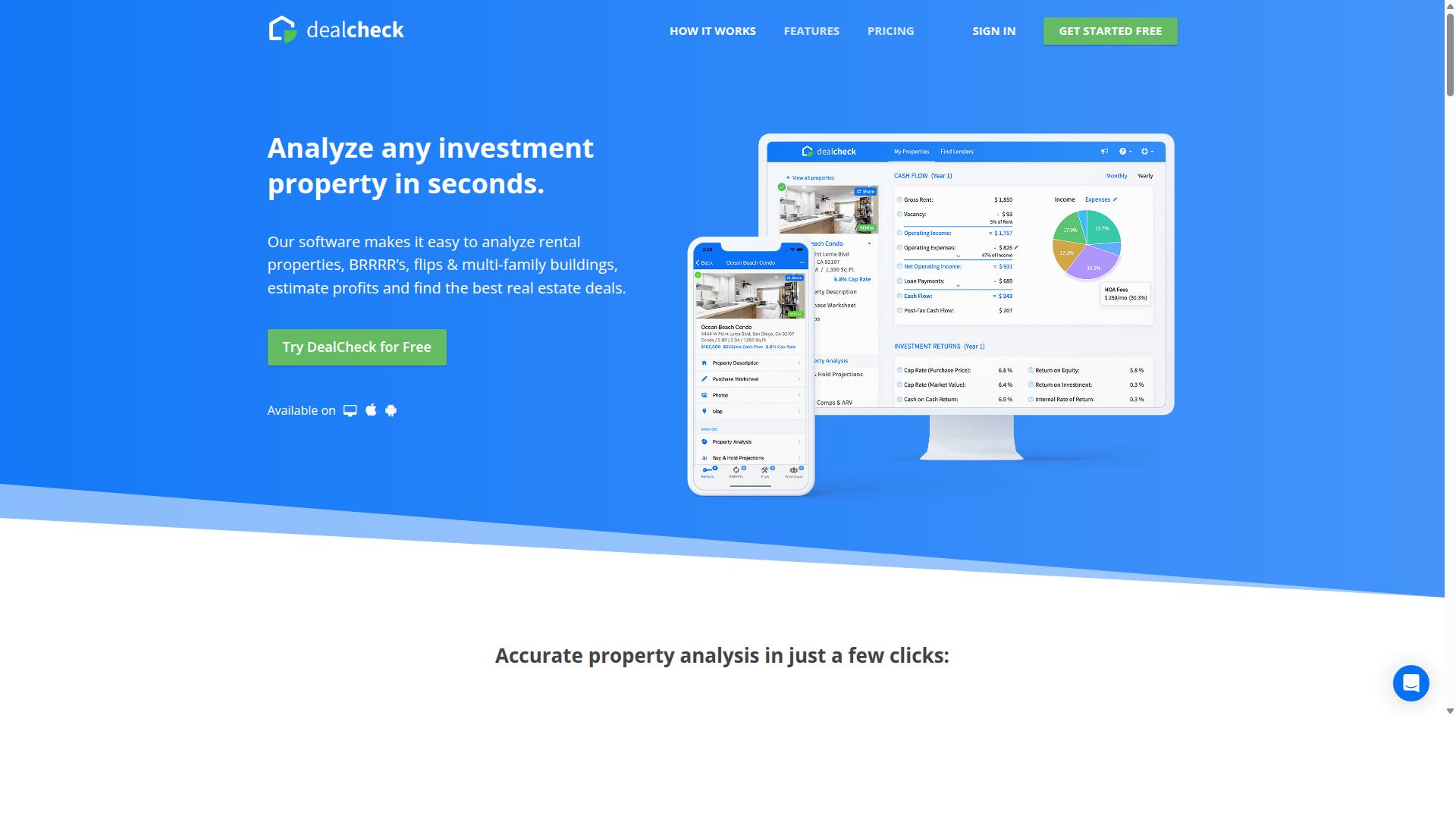
DealCheck delivers rental-property ROI and break-even timelines but does not model development-specific phasing or section 106 contributions.
The tool imports property data from public records and calculates standard investment metrics such as cash flow, cap rate, and internal rate of return. Users working on rental or flip projects receive quick insights without additional setup.
However, development teams often need more than basic metrics. DealCheck lacks native support for construction cost overruns or phased cash flow timing that feasibility.pro provides.
When professionals require residual land value calculations, they export CSV files to spreadsheets for manual adjustments. This workaround adds steps and increases the chance of errors during complex appraisals.
The service also omits built-in sensitivity analysis for variables like professional fees or finance costs. Teams must create separate scenarios outside the platform to test different outcomes.
While DealCheck meets the needs of many investors focused on existing properties, development appraisal tasks require additional tools or processes to complete full feasibility reviews.
4. Rentometer
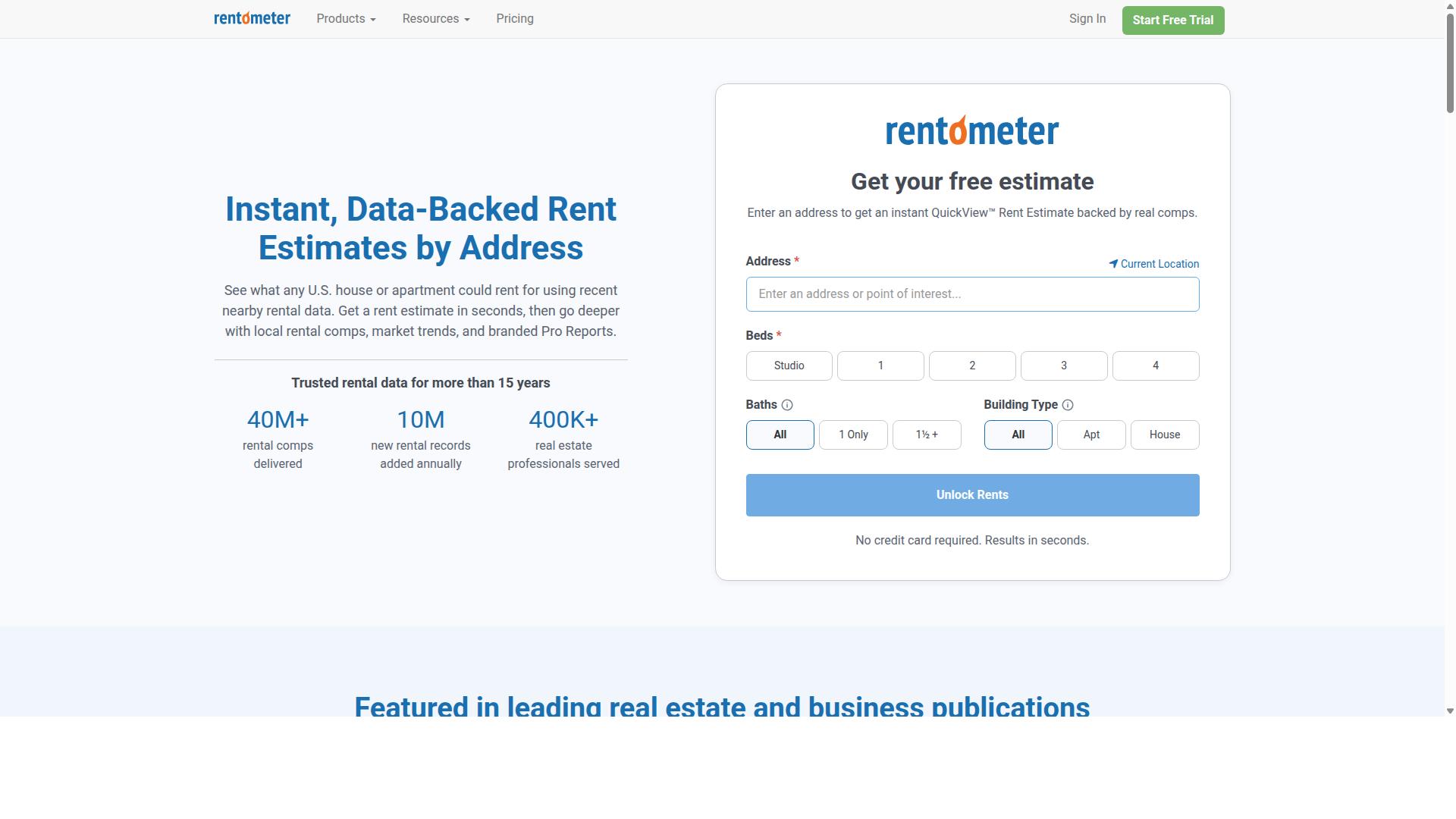
Rentometer supplies rental-comps and gross rent estimates but offers no tools for gross development value or construction-cost modeling. Analysts must copy-paste rent figures into external feasibility spreadsheets, introducing manual error risk. The service lacks NPV or IRR outputs required for full development feasibility studies.
Users can access QuickView estimates and Pro Reports that display average and median rents across local comps. The platform also provides historical trends, interactive maps, and public record data through its Essential and Pro plans. These features support rental research yet require additional steps for complete property development analysis.
The absence of integrated cash flow modeling means analysts handle separate calculations for residual land value and profit on cost. Professionals seeking a streamlined development feasibility calculator often combine Rentometer data with other platforms. This extra workflow increases time spent on data transfer and validation.
Real estate teams that need quick rental benchmarks may find value in the Batch Processor for portfolio reviews. However, those focused on comprehensive development appraisal must move rent projections into dedicated feasibility software. The extra steps highlight why integrated solutions reduce risk during site acquisition cost assessments and construction cost estimate reviews.
5. REI Wise
REI Wise provides multi-year cash-flow tables but does not integrate planning-obligations calculations or automated scenario phasing. Users must handle these components separately when preparing real estate development feasibility studies.
The platform focuses on vacation rental analytics rather than full development feasibility calculator functions. This limits its usefulness for complex property development analysis that requires detailed site acquisition cost modeling and construction cost estimate integration.
Users manually enter section 106 and Community Infrastructure Levy figures into the cash flow model. This manual process increases the chance of errors when calculating affordable housing contribution impacts on overall project viability.
REI Wise offers limited Monte-Carlo sensitivity capabilities for testing different development scenarios. This restricts users' ability to run comprehensive risk assessments across variables like sales revenue projection and finance costs.
Investors seeking detailed residual land value calculations may find the platform's short-term rental focus creates gaps in standard development appraisal workflows. The absence of automated phase modeling requires additional manual work to generate accurate profit on cost projections.
6. Homesage.ai

Homesage.ai offers AI-driven rental forecasts but lacks residual-land-value engines and finance-cost amortization schedules. The platform focuses on investment property search rather than full development feasibility modeling. Users export to third-party software for complete development-appraisal modeling.
The service scans off-market and MLS listings to surface deals matching user criteria. It applies computer-vision models to assess condition, estimate renovation costs, and generate a seller motivation score. Automatic calculations cover ROI, cap rate, rental income, cash-flow projections, and equity potential.
Users filter by investment potential, seller motivation score, property condition, location, price, and days on market. Features include saved searches, daily email updates, and a Chrome extension for instant insights. Pairing with Full Property Reports supports deeper due diligence.
The platform covers over 155 million U.S. residential properties but does not generate project-phasing timelines. Development feasibility requires construction phasing, staged financing, and milestone-based cost schedules that Homesage.ai does not provide. Users must export data for detailed cash flow modeling.
7. DealWorthIt
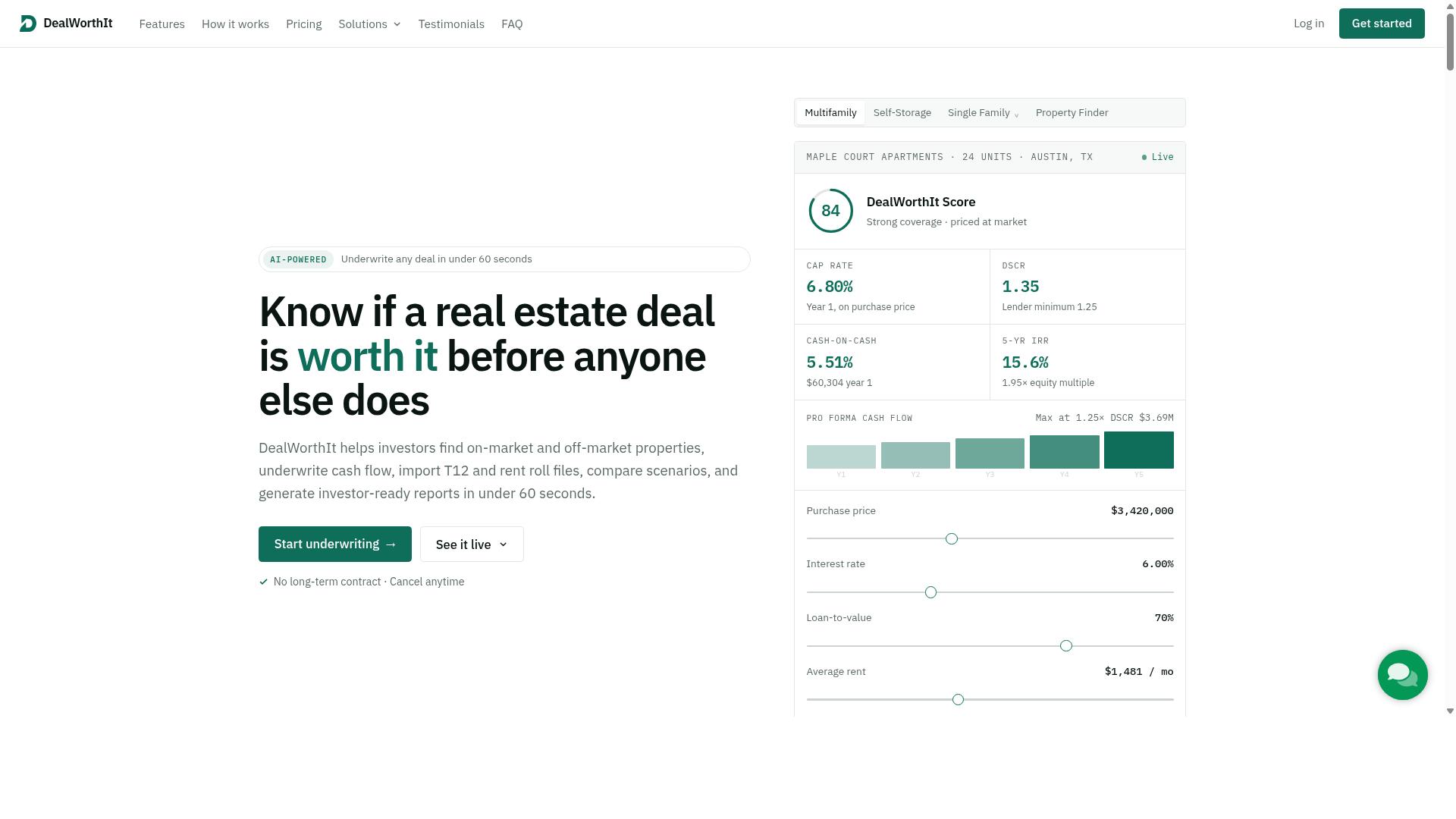
DealWorthIt focuses on fix-and-flip profit margins and does not accommodate multi-phase construction schedules or affordable-housing contributions. The platform centers on single-family and small multifamily acquisitions where investors need quick cash-flow estimates rather than full development appraisals.
Users perform break-even analysis on individual units only. NPV calculations remain unavailable, forcing analysts to replicate section 106 deductions manually when preparing formal planning submissions.
DealWorthIt imports T12 statements and rent rolls to underwrite buy-and-hold and wholesale strategies. Scenario comparison tools help evaluate different purchase prices and renovation budgets against projected exit values.
The software generates investor-ready reports from nationwide property data. Demographics, rent comps, and live SOFR rates feed into cash-flow models that support syndication packages and lender packages.
White-label options suit new investors and acquisition teams managing pipelines. Cancellation is available at any time without long-term contracts, though users seeking residual land value or profit-on-cost metrics must look elsewhere.
How to Choose the Right Option
The first step involves matching the calculator's feature depth to the investor's daily time budget and experience level before committing.
Real estate investors often juggle multiple responsibilities. Former 9-to-5 workers and small-business owners frequently dedicate 1-2 hours daily to property projects.
Choosing an overly complex platform wastes those limited hours. A tool with automatic residual-land-value outputs reduces manual entry.
Users should review how each solution handles section 106 and CIL obligations. Some platforms automate these calculations while others require manual adjustments.
| Feature | Tranchi AI | Other Options |
|---|---|---|
| Automated Residual Land Value Outputs | High | Medium to Low |
| Section 106 / CIL Handling | High | Medium to Low |
| Sensitivity-Analysis Breadth | High | Medium to Low |
| Import/Export Speed | High | Medium to Low |
| Onboarding Time | Low | Medium to High |
Beginner investors with no prior experience benefit from platforms that complete onboarding quickly. Rapid setup preserves time for actual property evaluation.
Small-business owners value fast import and export functions. These features allow seamless data movement between spreadsheets and the development feasibility calculator.
Users who prefer detailed sensitivity analysis should verify the breadth of scenarios each tool supports. Broad analysis helps identify potential risks across different market conditions.
Final Verdict
Tranchi AI's 44-agent suite delivers the only end-to-end workflow that merges off-market sourcing with full development feasibility modeling.
Users consistently give the platform a 5.0 rating across 2,742 active accounts. Many report an average $20K monthly upside after switching from conventional development feasibility calculator tools.
Tranchi AI's proprietary agents scan millions of probate court filings, auction websites, and government websites to surface sites before competitors see them. This data feeds directly into property development analysis modules that calculate residual land value, profit on cost, and gross development value within the same dashboard.
The built-in 90-day money-back guarantee lowers entry risk for investors who run 1-2 hour daily workflows. Teams using the Operator plan can also deploy a custom AI agent tailored to their specific cash flow modeling, sensitivity analysis, and scenario modeling needs.
Recommended Resources: